
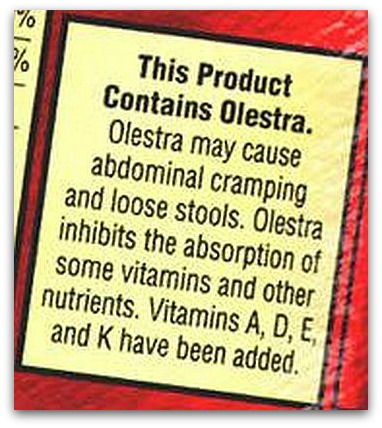
In the 1990s, the dream of a fat-free potato chip became a reality…along with some very gross side effects.
 In the late 1960s, Proctor & Gamble scientists were charged with creating a nutrition supplement to help premature babies gain weight quickly. They played around with sucrose molecules, manipulating them into different configurations in hopes that they would be more efficiently absorbed by the digestive tract. As is often the case, the science went horribly awry, and instead of creating something that would improve the lives of tiny, vulnerable babies struggling to survive, P&G accidentally invented Olestra, a substance that would allow people to eat as many potato chips as they wanted without feeling guilty.
Formally known as “sucrose polyester,” Olestra is a synthetic fat substitute which is made by altering the chemical components of sugar and oil. When used as a food additive, it replicates both the delicious taste and satisfying mouthfeel of fat. However, the molecules are too large to be properly absorbed by the intestinal tract. The hoped-for result: food that tastes rich and fatty, but isn’t absorbed by the human body and turned into body fat. A win-win, right?
Not exactly. The only problem, which turned out to be a significant one, was that if the fat you eat doesn’t get absorbed into your intestines, it has nowhere to go but out of your intestines. In less delicate terms, foods made with Olestra can cause people to experience what the Food & Drug Administration describes as “abdominal cramping and loose stools.” No one should have been surprised by this side effect; early safety testing with lab rats resulted in “anal leakage” and vitamin malabsorption. Because of this, P&G was engaged in a legal brouhaha with the FDA that stretched on for decades before Olestra was allowed on the market.
Ultimately, it was decided that Olestra could be used as a commercial fat substitute, with one caveat: Foods made with it had to carry a warning label so that customers would know not to stray too far from their bathrooms. In 1998, after 30 years of hard science and legal battles, Olestra made its debut in the form of Frito Lay’s “Wow!” brand of snack chips. Sales were initially impressive (“Wow! A savory snack that won’t make me gain weight!”), but then declined precipitously (“Wow! These fake chips are causing me to poop myself blind!”).
Studies later indicated that Olestra’s pants-ruining side effects were not as widespread as initially thought; i.e. not everyone who consumes the product suffers from uncontrollable diarrhea. That was good enough for the FDA, which no longer requires products made with Olestra to contain a warning label. Yet Olestra’s bad reputation proved hard to shake, and to this day most people would rather gain a little weight than take their chances with it. Happily, science found another use for sucrose polyester, which has been repurposed as a machine lubricant and an additive in deck stains.

Read about more weird inventions in Uncle John’s Weird Inventions.