Dog Islands

These far-flung locales are going to the dogs…that is if they haven’t already.

Snoopy Island

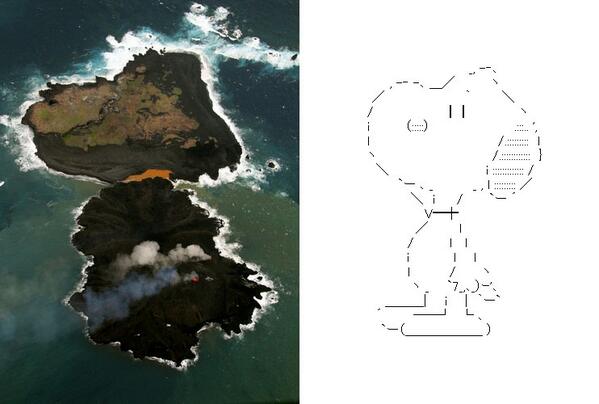
Snoopy IslandNishinoshima lies off Japan’s Pacific coastline and is best known for its active volcano, which last erupted in November. The ensuing lava flow created an entirely new island called Niijima. But the volcano wasn’t quite done. In the weeks that followed, it spewed out enough lava to connect the two islands as one. This strange event caused many a volcanologist to cry “good grief!” when they first saw aerial photos of the new, improved Nishinoshima: because the island now strongly resembles Snoopy. However, Japanese scientists aren’t ready to rename it “Snoopy Island” just yet. They say that the volcano is still active and that Nishinoshima’s current shape may only be temporary.

7 Quick Facts About Roses

All about the most famous, prominent, symbolic, and revered
flower in the Western world: the rose.

Facts about Roses• Humans began cultivating roses only about 5,000 years ago, in China and the Far East. But they’ve been used and enjoyed by humans for much longer than that. Ancient Egyptian mummies have been discovered wearing rose wreaths. Fossilized rose remnants have been found that date back 35 million years.

• A rosebush blooms on the wall of Hildesheim Cathedral in Germany. It started growing at about the same time the church was built, around 1010, making it the oldest living rosebush on the planet.

• In the early 1800s, Empress Josephine of France engineered the first modern-day “rose garden.” She had a lofty goal—a sample of every rose variety in the world. Her gardens at the Malmaison château housed 250 varieties of roses—helped along by a standing order to the French Navy to confiscate any rose plants or seeds found on enemy ships.

• Josephine’s garden made rose growing and collecting very popular in western Europe. In the mid-1800s, gardeners figured out how to crossbreed roses, to combine, for example, one rose’s color with another’s heartiness. The first major hybrid rose: “La France,” developed by grower Jean-Baptiste Andre Guillot in 1867. Today there are over 10,000 hybrid rose varieties.

• While it probably didn’t have every rose in the world, Josephine’s was the largest rose collection in the world until the opening and rapid growth of the Europa-Rosarium in Sangerhausen, Germany, in 1902. As of 2013, it houses 75,000 rose varieties.

Weird Invention: Here Comes the Fake Sun

A low-tech/high-tech cure for the winter blues for a city that is is cut off from direct sunlight for five to six months a year.

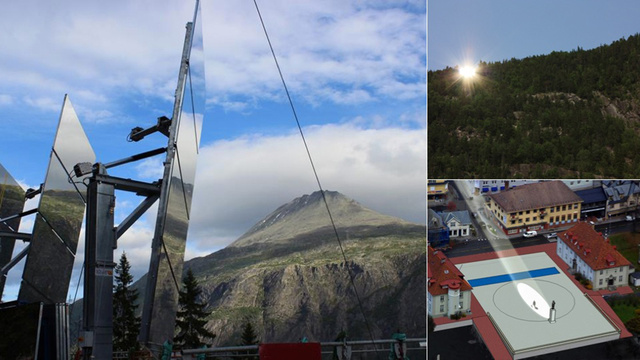
As the days grow shorter and the nights get colder, a little sunshine can be hard to come by. It’s especially true in Rjukan, a small town in Norway. Because of a nearby, imposing mountain chain, the area doesn’t receive any direct sunlight from September until March.

fake sun mirror project

Seven months of near darkness can get anybody down, as well as deprived of Vitamin D. Fortunately for the residents of Rjukan, there’s a high-tech cure for the wintertime blues.

Nearly seven months of that kind of gloom can get anybody down, even Vitamin D deprived Norwegians that are accustomed to harsh winters. Fortunately for the residents of Rjukan, there’s a solution. At a cost of 5 million Norwegian Kroner (roughly $841,000 in US dollars), three 183-square foot mirrors were installed on a cliff overlooking the town. On clear days – which are unable to discern from the ground in Rjukan – the mirrors reflect the sunlight down into the town square.

A Crappy Cup of Joe

If you think these coffees taste crappy, you wouldn’t be wrong. They literally came from poop. They are coffee from feces.

coffee from fecesIn one of the most inexplicable, perplexing, and kind of gross fads of all time, the hottest thing going in the world of coffee are beans that have passed through the digestive tracts of exotic animals. Adherents claim that the premium coffee that results is better than regular coffee. Why? The animals eat only the tastiest, ripest berries from coffee plants, then digest the outer berries, allowing the beans inside pass through their stomachs unharmed, but left coated with amino acids and enzymes. The animals’ feces is collected, with the beans removed, cleaned, and roasted, then ground into a beverage that fans claim is smoother and less bitter than other coffees because of those amino acids and enzymes from an animal’s digestive tract.

The most popular berries-to-butts-to-baristas blend is kopi luwak coffee, made from beans that have passed through the digestive system of the civet, an exotic mammal native to Asia and Africa, also known as a luwak or toddy cat. In 1991 British coffee importer Tony Wild became the first European to offer coffee made from pre-digested beans. The kopi luwak became so popular in Europe that its production is being industrialized, leading to widespread mistreatment of civets. Recently, Wild launched a campaign to end the production and consumption of the special coffee.

The Big Hunt for Bigfoot

Better living through Sasquatch-hunting technology.

“Drones” are seemingly everywhere these days (look out!). These controversial “unmanned aerial vehicles” are currently being used for military missions, surveillance, and even domestic policing. But drones aren’t just the possible progenitors of an Orwellian future. Their use is being explored in forest fire prevention, pizza delivery, and video tours.

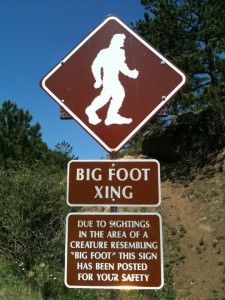
Hunt for BigfootAnother possible use: in the big hunt for bigfoot. Jeffrey Meldrum, an anthropology professor at Idaho State University, along with entrepreneur William Barnes, are spearheading a project that will use an innovative new type of drone to search for evidence that Bigfoot actually exists. They call their undertaking “The Falcon Project.” Barnes and Meldrum hope to find enough funding to build the Aurora Mk II, an unmanned, 45-foot-long airship equipped with thermal-imaging equipment and high-resolution cameras. It should be just the tool to scour the forests of the Pacific Northwest day and night, tracking Bigfoot, and, should it find one, take a picture. Unlike more conventional drones, their ship will be quieter and stealthier so as not to scare away their targets. The Aurora Mk II will also be able to travel at speeds of up to 45 mph. The team hopes to launch the ship next year and start sending it on nighttime runs over reputed Bigfoot hotspots around the United States. Over the years, there have been dozens of amateur films that claim to contain footage of real-deal sasquatches—but nothing has ever been confirmed. Earlier this year, however, a couple hiking in British Columbia captured a fairly convincing video of what may (or may not) be one.

Happy Birthday California!

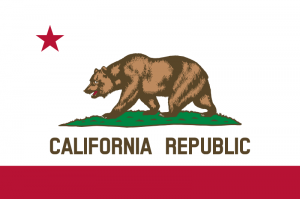
Happy birthday California (163 years old today!). Here are some amazing California facts from Uncle John’s Plunges into California.


16 CALIFORNIA EXTREMES

How much do you know about California’s highest, lowest, oldest, largest, and smallest stuff?

Happy Birthday CaliforniaTALLEST LIVING THING: Hyperion, a 379-foot Sequoia (California redwood) tree located in the Redwood National Park near Eureka. Hyperion’s location in the park is kept secret to prevent it from being damaged by tourists.

SMALLEST MOUNTAIN RANGE: The Sutter Butte Mountain Range near Yuba City. The buttes are a circular volcanic outcropping just 10 miles in diameter.

OLDEST LIVING TREE IN NORTH AMERICA: A 4,842- year-old bristlecone pine in Inyo National Forest outside Bishop.

Named Methuselah (after the oldest person whose age is referenced in the Bible), this pine was a seedling during the Bronze Age, when the Pyramids were going up in Egypt.

LARGEST LIVING TREE: General Sherman, a giant sequoia in Sequoia National Park, east of Visalia. Named for Civil War general William Tecumseh Sherman, this tree weighs more than 2 million pounds, is 275 feet tall, and is the largest tree on earth when measured by its estimated volume of 52,513 cubic feet.

BIGGEST SOLITARY BOULDER: Giant Rock in Landers in the Mojave Desert. At about seven stories high, it weighs more than 23,000 tons.

LONGEST RUNWAY: At Edwards Air Force Base in the Mojave Desert. It’s 7.5 miles long, and the first space shuttle landed there.

WORLD’S TALLEST ONE-PIECE TOTEM POLE: Built in 1962, the brightly painted 160-foot-tall pole in the McKinleyville Shopping Center was designed by Ernest Pierson, who carved it from a single 500-year-old redwood.

OLDEST CONCRETE BRIDGE STILL IN USE: Fernbridge in Humboldt County. Built in 1911 of reinforced concrete, it crosses the Eel River and is 1,450 feet long.

HIGHEST LANDING PAD ON A BUILDING: The U.S. Bank Tower in downtown L.A. is 1,018 feet high, making it the world’s tallest building with a helipad on the roof. It’s also America’s tallest building west of Chicago.

NORTH AMERICA’S BEST VIEW OF THE WORLD: The 3,849-foot summit of Mt. Diablo in Contra Costa County. It reveals more of the earth’s surface than any other peak in the world, except Mt. Kilimanjaro in Africa. Mt. Diablo looks west to the Farallon Islands in the Pacific, east to the Sierra Nevada mountain range, south to the Santa Cruz Mountains, and north to the Cascades.

NORTH AMERICA’S HIGHEST CONCENTRATION OF LAVA TUBE CAVES: Lava Beds National Monument near Tulelake.


Famous For Fifteen Minutes: Grand Canyon Stunts

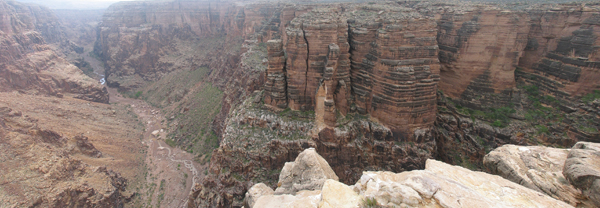
There’s something about America’s biggest hole in the ground that seems to lure thrill-seekers into believing that they simply must risk their lives and navigate it somehow. In June, seventh-generation tightrope walker Nik Wallenda successfully walked over the Grand Canyon on a two-inch-wide cable, without a safety harness or net while the Colorado River roared thousands of feet below him. (And all on live TV.)

grand canyon stunts

Here are two more possibly less-than-sane individuals and their death-defying Grand Canyon stunts.

No Whey? Yes Whey: The Truth About Greek Yogurt

The truth about greek yogurtA few years ago, a new product hit your grocer’s dairy case seemingly out of nowhere: Greek yogurt. It’s an extra-thick, extra-creamy, and protein-heavy version of. The main difference, besides the thick, almost cheesecake-like consistency: There’s very little liquid in a container. Popular brands include Yoplait and Chobani. And Ben and Jerry’s has a frozen version. How popular is Greek yogurt? In New York state alone, production at yogurt plants has tripled over the last five years to more than a billion pounds per year. Want to know the truth about Greek yogurt?

Big Noise, Little Bug: The Cicadas are Coming!

As the East Coast prepares for the cicadas invasion due sometime in the next month, we dig in our vault to find some more information about this tiny, yet noisy bug. The following article is from Uncle John’s Fully Loaded Bathroom Reader.

BIG NOISE, LITTLE BUG

Cicadas are the vuvuzelas of the insect world. (What are vuvuzelas? Those loud horns that nearly caused soccer fans’ brains to explode during the 2010 World Cup.) Vuvuzelas reach a decibel level of 60, but cicadas? These little bugs can reach a decibel level twice that loud.That’s as loud as a rock concert or a jet engine.

BROODY BUGS

CicadasCicadas are bizarre, especially the “periodical cicadas” that live only in eastern North America. What’s odd about them is that they’re on either a 13- or a 17-year cycle. They emerge in “broods” of so many bugs it’s like some shock-and-awe insect invasion, make a lot of deafening noise, mate, lay eggs, and, within just a few weeks, die. Then they disappear again for an another exact number—13 or 17—of years. Entomologists are still trying to figure out what makes periodical cicadas tick. The main problem: those long cycles. It’s difficult for scientists to study an insect that shows up only once or twice in their careers. The name cicada is Latin for “tree cricket,” which is actually incorrect: cicadas are not crickets. And though one species is commonly called the “17-year locust,” they’re not locusts, either. Locusts are “eating machines” that can devour entire crops. Cicadas don’t eat leaves; they’re sapsuckers, like their closest relatives leafhoppers and spittlebugs. Cicadas have also been called “jar flies,” “harvest flies,” and “dust flies,” but their Australian nickname, “galang-galang,” which echoes the racket they make, may be the most fitting.

Gill Communication? 3 Weird Fishing Techniques

fishing techniques
Some guy with a really BIG fish.

Fishing is definitely not for the impatient, especially during winter. Have you ever tried ice fishing? It’s fun…if you enjoy sitting in a frosty shack while waiting for a nibble that may never come. Naturally, many fishermen have tried to take the tedium out of angling. The following three fishing techniques will certainly increase your chances of a big catch.

Sir Ranulph Fiennes is the Bravest Man in the World

Ranulph FiennesSo you’ve probably never heard of Ranulph Fiennes. No, he’s not the father of actor Ralph Fiennes (they’re actually third cousins). All you need to know about him is that he’s one of the most fearless—and curious—people on Earth. It’s even official. In the 1980s, Guinness World Records named the British writer/adventurer/knight/politician “The World’s Greatest Living Explorer” by the Guinness Book of World Records. Now nearly 70, Fiennes continues to embark on incredibly dangerous expeditions. His many adventures could easily fill a dozen biographies, but here are a choice few.

Surfing Killer Whales! [Updated]

It’s becoming more common to call them orcas rather than killer whales, but it makes the title of this story so much more exciting:

But when a one-metre-tall fin popped out of the water and started heading towards him and other surfers, Mr Cunningham decided to head ashore. “I didn’t have anything to sit on and with most of my body under the water, it felt a bit freaky.” The other surfers had stayed at sea unfazed by the visitors.

After catching a wave Mr Cunningham had noticed the orcas had caught a wave behind him.

Fish Regurgitation Banned at Sydney Circus

The Aussies just say no to Puke My Fish Up:

Circus-goers in Australia hoping to see a woman swallow and then regurgitate a live fish will be disappointed, as authorities decided it was cruel to the fish.

Now just what the heck is going on in the world when a person can’t get the kids together, put ’em in the station wagon, and take them down to the circus to watch a lady swallow a live fish and then throw it back up again, still alive? What kind of a world? Next we’ll hear you can’t throw kittens in trash bins! “It was fun,” for goodness sake!

Water Striders’ Mating Blackmail

A creepy yet fascinating insect story from Discover:

Hyper-violent males can sometimes wear the female down but some opt for a subtler approach – they tap intricate rhythms on the water with their legs. When Han and Jablonski discovered these rituals last year, they suggested that the males might be trying to demonstrate their quality, by tapping out the most consistent rhythms. Now, they have another explanation – the tapping is a form of blackmail, a way of coercing sex from the female with the threat of death.

The duo studied the preferences of the backswimmer – a predatory bug that floats upside-down at the water’s surface and listens out for the vibrations of potential prey. When given a choice between a silent male water strider and a mating pair with a tapping male, the backswimmer always headed towards the vibrating duo. And since these predators attack from below, the female was always the one who was injured while the male strode off to tap another day.”

Headline Writing, Part Eleventy Million

There’s a headline over at GrindTV right now that says this:

“Marlin goes berserk, attacks press boat during Hawaii tournament”

We here at the BRI enjoy taking our luxury yachts on fishing trips to exotic locales around the world as much as anyone—but can you give a fish a break here? It had a hook in its face. Does reacting to that qualify as going “beserk,” and “attack[ing]” a boat? It may have just wanted to, you know, get the hook out of its face.

Rare 90-Year-Old Tree Flowers for the First Time

Very cool story from the wild world of, well, the Wild:

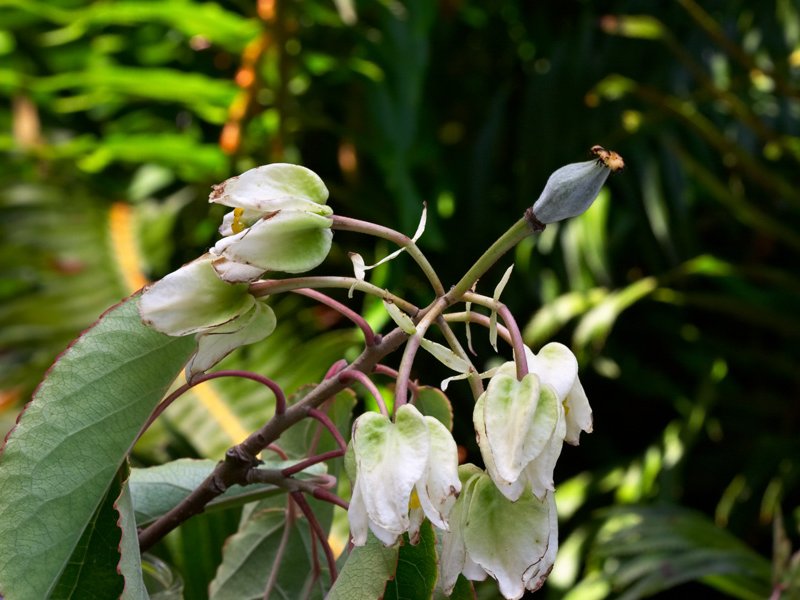
One rare tree specimen in Ireland is proving that it’s never too late to try something new. Some 90 years after being planted on an estate outside of Belfast, a Goat Horn Trees [sic], native to China, is flowering its pale, aromatic blossoms for the very first time ever. Sadly though, it’s attempt to find another tree with which to reproduce will likely be in vain as there’s only one more like it in the whole country.

Sad little tree.

Here’s some more information on Carrierea calycinea, and a nice pic of the tree’s flowers: